There are two ideas that are very close to my heart and to my current state of mind.
On the one hand is my current obsession with healthcare, my desire to change the status quo. Along with it is a question I have been hearing for the better part of the year: what would I build next? If I was not building CLARO?
The second one is that passion I have for movies. For old movies, for all movies, to be honest. And how the Alien franchise, through more than 40 years of movies, has been showing us one of the most important pieces in space exploration that apparently, while the current fashion is to build rockets and terraform planets for us to colonise, we seem to forget.
The combination of these two thoughts has made me spend my Sunday morning and the occasional flight delayed to play around with an idea.
And well, as I said in my previous Log 003, I have not spent the time researching the problem at depth so as not to draw my obsession away from CLARO, where I spent a full year if not more doing market research, user need and commercial viability. But I have still done enough to imagine that future passion project. Something that could perhaps become an obsession. That big sci-fi moonshot I would be happy to retire working on.
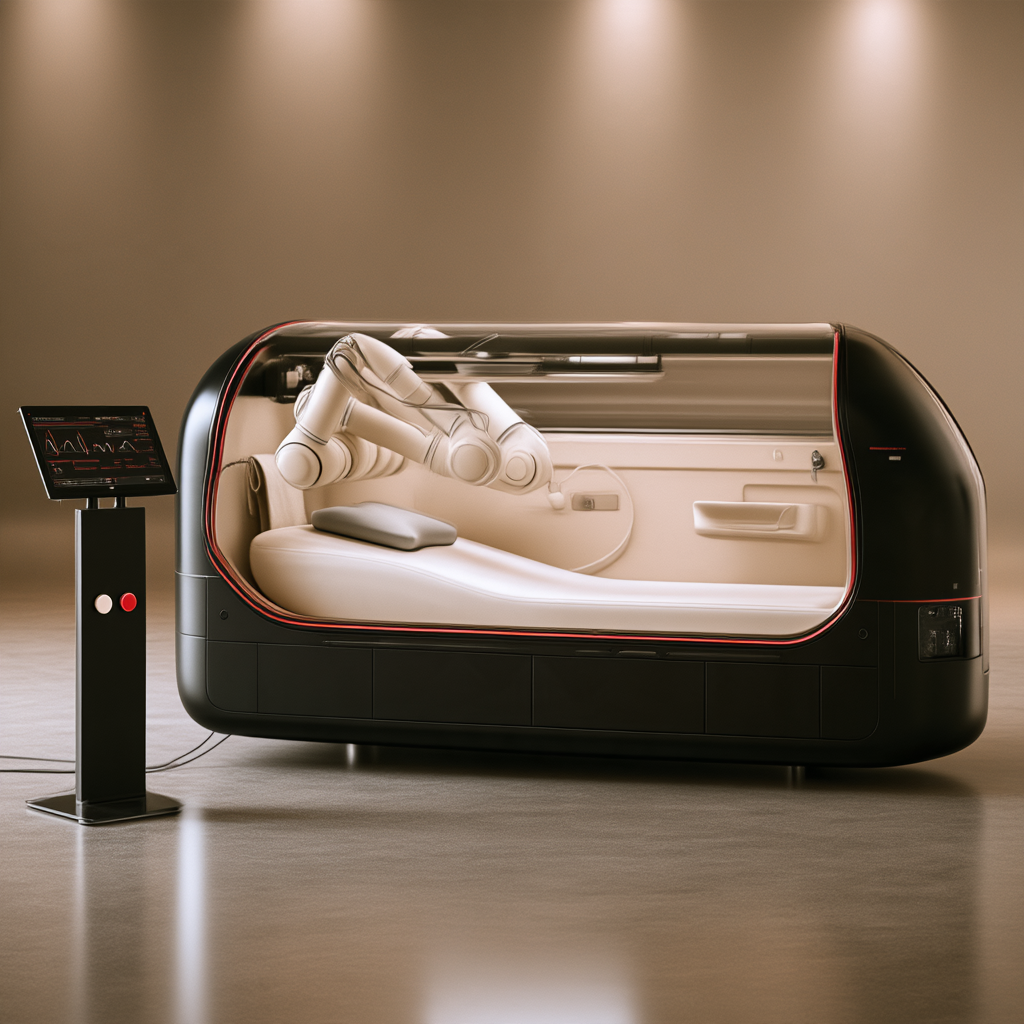
A medpod or a medical pod, as originally introduced in the first Alien movie as part of the medical bay equipment aboard the Nostromo vessel, capable of basic wound repair, scans, & bone setting. Something that later movies improved regarding its surgical capabilities, where in Prometheus the Pauling MedPod 720i was capable of removing a "foreign object" from a crew member.
Now, I have been looking at this space and thinking how scientifically interesting it would be, or at least how cool it would sound, to see that we have created such a complex and precise surgical machine in such a small form factor. To serve us not against an alien invasion but to keep us safe wherever we go.
Now, this is not something I could be thinking of doing right now.
§ 02
The use case I would feel most passionate about would be placing these pods in any spaceship and colony that we build on Mars, the Moon and beyond.
I mean, in 2024, a miniature surgical robot was already sent to the ISS, the International Space Station, to practise simulated surgery in space.
We already have developments in low-dose CT scans. I even have a friend who found a way to do patient intubation with a robot.
That future of a medical pod that can autonomously take care of a patient is getting closer and closer. All you have to do is put together these different pieces of a jigsaw and complete the bigger picture.
Even I have spent the better part of this decade obsessing about tracking patients with millimetre accuracy through spatial computing. Unknowingly solving one of the many problems a medpod would throw in our way.
I can see the use case as clear as a river in the swiss alps.
Today, on an oil rig, if there's a bad accident, you will need a helicopter for medical evacuation.
If you're on the Moon, you are days away from Earth to get back and be treated.
If you're on Mars, it's not just the fact that you are months away from home, but if you try even to perform teleoperation, any message you send is going to take between 4 and 24 minutes to reach Earth, and another 4 to 24 minutes for a response.
So the need for reliable surgical care, perhaps not necessarily to complete the full surgery, but to control the situation, to mitigate the risk, to stabilise a patient so a general doctor can provide further support rather than requiring a specialist surgeon, starts to make sense, right?
Perhaps in places like a warship stationed at the edge of a war zone, where a medical pod like this could stabilise a trauma patient for hours or days until a specialised surgeon is available.
§ 03
I, of course, could not help it and delved into the rabbit hole to entertain myself in my free time.
I ended up finding out about all the work DARPA has been doing and the calls for action they have put out, looking for the pieces of this jigsaw I am envisioning.
DARPA themselves have identified this unmet need around the golden hour, when no surgeon is available on a battlefield, ship, remote mine or disaster zone.
They have programmes focused on autonomous trauma care, automated resuscitation, haemorrhage control, casualty assessment, treatment recommendations, guidance and clinical documentation. Software that monitors the quality of care and documents interventions automatically...
§ 04
While the idea of a medical pod right out of a movie about aliens may feel a little bit new, the concept of a pod that provides medical care is not.
FORWARD raised $657 million to build room-sized pods that they would place in shopping malls, gyms and office buildings, giving healthy patients the opportunity for continuous monitoring and certain types of medical support.
They, of course, went down. My interpretation is that healthy patients don't necessarily want to pay a recurring healthcare fee for a value proposition that was yet to be clearly defined, unlike the proposition of companies like Superpower in the US or AEON Health in Europe.
But they proved that this vision is fundable.
Now, when you throw the full weight of defence and space exploration budgets and their needs behind this technology, it's no longer just a matter of building something that individuals will pay money for.
It becomes a question of how much a government or a critical infrastructure operator needs to invest to keep their people safe.
Because a patient on an oil rig, once stabilised, could potentially wait for a couple of days for a specialist to arrive, or even have a generalist doctor on site provide further support after stabilisation.
But if a specialist is not on site when the accident happens, or no rapid medical evacuation helicopter is readily available, there may be little hope for this one person.
The same can happen on the Moon. The same will happen on Mars.
And when we talk about journeys and long colonisation missions that may take years, we need to make sure that whatever happens, we are ready to deliver the best care possible, as we do in big modern cities and try to across the rest of Earth.
Because not all of us are as strong and resourceful as Matt Damon in the movie The Martian.
§ 05
If I was to build this pod, I could call it the 720i, just because I am that kind of nerd and movie aficionado.
And of course, the name of the company should be Pauling.space. Again, I am that kind of nerd and movie aficionado.
But for any other reader not super excited about high-quality classic sci-fi movies, they could just think that the company is named in honour of Linus Pauling, who won two Nobel Prizes, one for Chemistry and one for Peace.
So it could make sense for a company working towards democratising access to healthcare.
If I was to build this pod, here is a list of things I would work on incorporating:
01Vitals and continuous monitoring · Continuous tracking of the patient's physiological condition.
02Blood testing · Onboard analysis to support diagnosis and treatment decisions.
03Robotic ultrasound · Robotic arm, ultrasound probe and predefined protocols for internal bleeding (eFAST), thrombosis (DVT) and cardiac assessment.
04Portable MRI or CT · Compact medical imaging for internal diagnosis.
05AI diagnosis and triage · Combine vitals, blood tests and imaging for autonomous clinical assessment.
06Offline clinical AI · Onboard AI capable of diagnosing, planning, explaining and supporting clinical decisions without communication with Earth.
07Robotic vascular access · Ultrasound-guided IV, intraosseous and central-line placement. Defined anatomical targets.
08Chest decompression and drainage · Robotic treatment of pneumothorax using needle decompression or chest drains.
09REBOA · Robotic placement of an aortic balloon to temporarily control severe internal bleeding.
10Fracture reduction and fixation
11Robotic airway management
12Robotic wound closure and bleeding control · Autonomous suturing and haemostasis in soft tissue.
13Robotic drainage · Image-guided drainage of abscesses and fluid collections.
14Autonomous appendectomy and cholecystectomy
15Automated sedation · Closed-loop drug delivery using continuous physiological feedback.
16Automated fluids and transfusion · AI-controlled fluid and blood administration based on haemodynamic monitoring.
17Autonomous intensive care · Multi-day monitoring, ventilation, drug delivery and treatment within the same medical pod. Essentially an integrated robotic ICU.
18Patient restraint and positioning · Mechanical engineering adapted to zero gravity.
20Clinical documentation and handover · Automated records and structured communication. Mostly software. DARPA's D2 programme is already funding innovation in this area.
§ 06
I'm not building this. At least not now.
CLARO is the only thing I think about. I wake up thinking about it and go to sleep thinking about it. I'm obsessed with what we're building, and scaling it is my priority.
Pauling.space is something I would love to build or invest in one day. Maybe when I retire, if I ever do.
But I also know that ideas are worth very little if nobody executes them. And perhaps someone reading this has the resources, the team and the time to make it happen.
So please, go ahead.
The website, colours and font inspiration, the deck I have attached on the P.S., even the name... they are all yours if you want them (unless I launch this first, but you've got plenty of time, haha).
Ideas cannot be licensed, and I wouldn't want to. So this part is just a request. If you drew any kind of inspiration from this and found it reenergising, please credit me where people will see it. Your About page, your credits, your launch post. Not buried in a footer.
And if you ever build it, please let me know. I would love to see it in person. Maybe I'll even write you a cheque.
Signed, Moises
P.S. I could not resist. I put a one-page site at pauling.space and a six-slide concept deck with the renders, the colours and the fonts, here as a PDF.
The 720i. Concept render.
This article and its original designs, deck and images are licensed under CC BY 4.0, where I hold the relevant rights. Credit: "Original concept by Moises Barbera Ramos" with a link to this article, shown on your website's About or Credits page.